Big room or small room? How venue size changes an electronic night
A packed festival field and a close club room ask different things of the music, the crowd and your night. Here’s how to choose between them in Dubai and around the region.
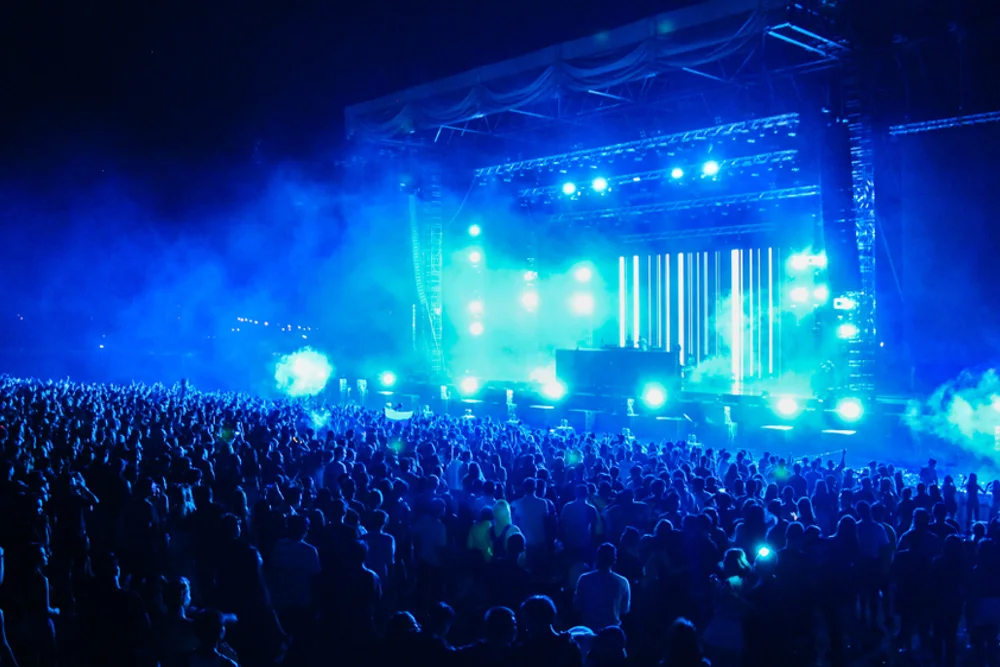
5 min readPhoto: Leonardo Wasanawanich / Shutterstock.
A bigger stage changes the evening
People sometimes use ‘rave’ to mean a big outdoor event and ‘club’ to mean a room with a door. That’s a handy first sketch, but size alone doesn’t tell you whether the night will suit you. A festival’s scale changes how you move through it: you may choose between stages, walk longer distances and plan around a much larger site. In a club, you can usually stay with one room and follow one musical thread.
Riyadh’s Soundstorm shows what the large format can look like in this part of the world. The 2025 edition was held over three days, with 14 stages and more than 250 artists, according to its organiser MDLBEAST. That scale gives you options, but it also means you can’t catch everything. It helps to pick a few must-see sets, leave gaps for discovery and check the site map before you arrive. MDLBEAST’s Soundstorm 2025 recap
Dubai’s electronic calendar includes both large outdoor productions and club nights. The label on a listing matters less than the details: venue layout, number of stages, set times and how far apart the rooms are. A multi-stage event may feel like several nights stitched together; a single-room club can make one DJ’s set the centre of the evening. IQ’s 2026 Middle East market report
What you hear depends on the room too
A huge system can make low frequencies physical and give a headline performance room to unfold. But a crowd spread across a broad site won’t hear every point in quite the same way. At a smaller venue, the sound can feel more immediate and the DJ’s choices easier to follow from track to track. That depends on the room, system and where you’re standing, of course; a small space isn’t automatically better tuned, and a festival stage isn’t automatically louder or clearer.
Production also has a less glamorous side: it has to work for a lot of people in a temporary environment. A technical account of Soundstorm 2025 by audio provider Clair Global describes the work behind the Big Beast stage, including audio, communications and data systems. It’s a reminder that festival sound is an engineering job across a site, not just a stack of speakers by the DJ. Clair Global’s Soundstorm production account
If the music matters most, look beyond the event’s scale and listen to the artists. A room with one carefully chosen booking may be a better fit than a spectacular lineup that only partly matches your taste. Conversely, if you want to move between styles or discover names you don’t know, multiple stages can make the ticket feel like a day-long browse.
Photo: DavideAngelini / Shutterstock.
Dubai, Riyadh and Abu Dhabi aren’t interchangeable
It’s tempting to talk about a single ‘Middle Eastern scene’, but the event landscape varies by city, venue and organiser. Dubai’s calendar spans club rooms, beachside programming and large-format shows. Riyadh’s Soundstorm is a specific, large-scale Saudi festival, not a template for every night in the Kingdom. Abu Dhabi has its own arena and festival infrastructure, with a different calendar and mix of events. Even within one city, two promoters can build very different nights.
Trade publication IQ’s 2026 market report makes this distinction directly: regional operators describe markets with different audience behaviour, price sensitivity and programming preferences. That’s a useful check against treating a Dubai club booking, an Abu Dhabi arena show and a Riyadh festival as equivalent just because all feature electronic artists. IQ’s regional market reporting
So what should you book? Pick a club if you want to stay close to one room and one musical direction. Choose a festival when the range of artists, stages and production is part of the appeal, and you’re happy to plan around a larger site. Neither format guarantees a better crowd or better sound. The event details, the artists and the way the night is organised do the real work.
Three checks before you buy
First, look at the site map and set times when they’re published. If your must-see acts overlap, decide that before the night rather than trying to sprint between stages. Second, check what your ticket includes and whether transport, re-entry or a separate room requires anything extra. Third, read the venue’s current entry information; don’t assume last season’s bag rules or timings still apply.
For a club, check whether the listing is for a dedicated dance room, a lounge event or a broader nightlife programme. For a festival, check how the stages are arranged and how late the final transport runs. These details are more useful than guessing what ‘rave’ or ‘club’ means on a poster.
For a group, pick a simple meeting point before splitting up, especially at a multi-stage site where phone signal or battery can become a nuisance. At a club, decide whether everyone wants to stay in the same room or is happy to drift between spaces. Those small choices make the scale feel manageable instead of turning the evening into a headcount exercise.
Dubai’s best choice depends on the night you want: one focused room or a larger musical map to explore. Start with the lineup, then choose the scale that fits your energy and your plan home.